Rates · 9 min read
Fed rate hike: what it means for UAE buyers and refinancing
 Sarah ChohaibAuthorPublished 17 September 2026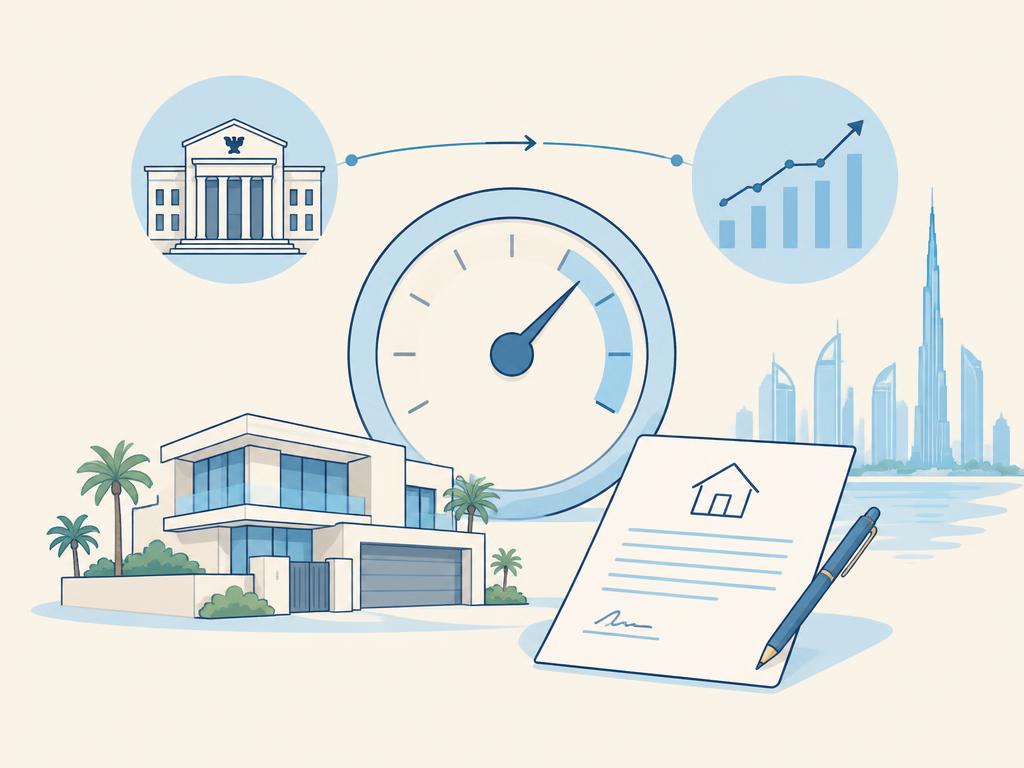
The Fed rate hike UAE mortgages story matters because the UAE dirham is pegged to the US dollar, so the UAE Central Bank moved its Base Rate up 25 basis points after the Fed raised its target range to 3.75%–4.00%. For buyers, this makes rate comparison and reversion margins more important. For refinance clients, it rewards fast break-even maths, not panic switching.
The Fed has moved again, and UAE mortgage borrowers should not treat it as distant American noise. On 16 September 2026, the Federal Reserve raised its target range by 25 basis points to 3.75%–4.00%, saying inflation remains elevated and policy is still aimed at returning inflation to 2%. One day later, the UAE Central Bank raised its Overnight Deposit Facility Base Rate from 3.65% to 3.90%. That is the bridge from Washington to your Dubai mortgage payment.
The important point is not just that rates rose by 0.25 percentage points. It is that the direction of travel has changed the decision for anyone buying property, sitting near a fixed-rate expiry, or considering a refinance. In a falling-rate market you can afford to wait a little. In a hiking market, waiting is a bet that tomorrow's bank panel will still be kinder than today's. Sometimes it will be. Often it will not.
Why a US Fed hike hits UAE mortgage rates
The UAE does not run mortgage pricing in isolation. The dirham is pegged to the US dollar, so the UAE Central Bank generally tracks US policy to maintain that peg. When the Fed raises or cuts, the local base rate usually follows quickly, and EIBOR — the benchmark sitting underneath many variable and reversion mortgages — moves in the same direction. That is why a Fed meeting can matter more to a UAE buyer's rate than a strong property-sales report in Dubai Marina or Jumeirah Village Circle.
If your offer is a fixed introductory rate, the bank is still pricing it with an eye on its funding cost and the expected path of EIBOR. If your loan is variable, the link is more direct: your contract says EIBOR plus a bank margin, and the EIBOR component resets at the tenor in your offer letter, often every one or three months. The market headline is macro. The payment change is very personal.
What changed after the September Fed decision
The official Fed move was a 25-basis-point hike. The official UAE move was also 25 basis points, taking the CBUAE Base Rate to 3.90% effective 17 September 2026. The language around the decision matters: the Fed did not declare victory over inflation. It repeated that inflation remains elevated and that policy decisions remain data-dependent. That keeps future hikes on the table rather than closing the cycle.
Reuters reported that Fed projections still pointed to further tightening, with 16 of 18 policymakers expecting at least one additional 25-basis-point hike by year-end. That is not a guarantee. It is a signal that borrowers should model the next move as seriously as the one that just happened.
| Decision point | Move | Why it matters for UAE mortgages |
|---|---|---|
| Federal Reserve | +0.25 percentage points to 3.75%–4.00% | Sets the dollar policy direction the UAE broadly follows |
| UAE Central Bank | +0.25 percentage points to 3.90% Base Rate | Feeds local bank funding and benchmark-rate expectations |
| EIBOR-linked mortgages | Reset by contract tenor | Variable and reversion payments move at the next reset, not instantly for everyone |
| New fixed offers | Repriced by bank campaign | Banks may adjust fixed campaigns before or after the benchmark move |
Our view on future hikes
Our base view is simple: assume at least one more hike is possible, but do not build your property decision around a heroic rate forecast. The Fed is reacting to inflation and labour-market data that can change month to month. If inflation cools faster than expected, the Fed can pause. If inflation remains sticky, another 25-basis-point increase is realistic. For UAE borrowers, the practical answer is to stress-test your mortgage at today's rate plus another 0.25 to 0.50 percentage points.
That view is intentionally conservative. It avoids the mistake of telling buyers to rush blindly, and it avoids the equal mistake of telling them to wait for cuts that may not arrive on their completion timeline. You do not need to predict the Fed perfectly to make a good mortgage decision. You need a structure that survives if the Fed is wrong-footed by inflation again.
The borrower mistake we expect to see now
The biggest mistake after a hike is comparing only the lowest fixed headline. A bank can show a slightly cheaper one-year fixed rate and still be worse once you include the reversion margin, arrangement fee, salary-transfer condition and how fast the fixed period expires. In a hiking environment, the rate after the fixed period becomes more dangerous, not less. If that margin is punitive, the cheap headline is a trap with a delayed bill attached.
What this means for UAE buyers
For buyers, the hike does three things. First, it reduces affordability at the margin because a higher rate means a higher monthly instalment for the same loan. Second, it makes pre-approval more urgent because your budget should be tested against current bank pricing, not last month's screenshot. Third, it raises the value of a broker comparison because banks do not all reprice at the same speed or with the same appetite.
A 0.25 percentage point move rarely destroys a transaction by itself. On a AED 2,000,000 loan over 25 years, the jump from 3.89% to 4.14% lifts the indicative payment from about AED 10,436 to about AED 10,712, a difference of roughly AED 276 a month. The danger is not one hike. The danger is stacking two or three hikes, adding a high reversion margin, and discovering too late that the debt burden ratio is tighter than expected.
| Indicative rate | Monthly payment | Change vs 3.89% |
|---|---|---|
| 3.89% | AED 10,436 | — |
| 4.14% | AED 10,712 | +AED 276/month |
| 4.39% | AED 10,992 | +AED 556/month |
| 4.89% | AED 11,564 | +AED 1,128/month |
The right response is not to abandon the purchase. It is to become stricter. Get pre-approved before negotiating. Compare fixed periods and reversion margins side by side. Keep enough cash buffer after the down payment and fees. If your affordability only works at the absolute lowest advertised rate, the file is too fragile for a hiking cycle.
Fixed or variable after a Fed hike?
A fixed rate buys time. That matters when policy is still uncertain and another hike is possible. For a buyer who plans to hold the property for several years and wants payment certainty, a one-to-three-year fixed product is usually easier to live with than a pure variable structure. The caveat is that the fixed rate is only the first half of the deal. The reversion margin tells you what happens when the safety blanket ends.
Variable can still make sense for a borrower with a large income buffer, a short expected holding period, or a strong view that the Fed is close to the end of the cycle. But it should be chosen deliberately, not because the starting payment looks slightly cheaper. If rates rise again, the variable borrower feels it first. If rates later fall, the same borrower benefits first. That trade-off is acceptable only when the monthly budget can absorb both directions.
- If your income buffer is tight, prioritise payment certainty over trying to outguess the Fed.
- If you may sell within one or two years, compare exit costs and early-settlement terms before choosing a long fixed period.
- If you choose fixed, compare the reversion margin with the same seriousness as the headline fixed rate.
- If you choose variable, stress-test another 0.50 percentage points before you sign.
What this means for refinancing
For refinance clients, a Fed hike does not automatically mean refinance today. It means check whether your current loan is already worse than the market after fees. The UAE early settlement fee is commonly capped at 1% of the outstanding balance or AED 10,000, whichever is lower, and switching also brings registration, valuation and bank charges unless the new lender absorbs some of them. The question is break-even, not fear.
A borrower on an old high fixed rate or an expensive reversion margin may still save money even after a hike, especially if the current bank has not offered an internal switch. A borrower already sitting on a sharp fixed rate may be better off waiting and preparing documents three months before expiry. The same Fed move can mean 'move now' for one borrower and 'do nothing yet' for another, which is why generic refinance advice is usually weak.
| Your situation | Likely best action | Why |
|---|---|---|
| Fixed rate expires within 3 months | Compare refinance and internal switch now | Your next instalment may reset into a higher EIBOR environment |
| Already on variable EIBOR + high margin | Test a buyout immediately | The bank margin may be the bigger problem than the latest hike |
| Locked below current market for 12+ months | Prepare, but do not rush | Breaking a good fixed rate can destroy the economics |
| Need cash from property equity | Compare buyout plus equity release | A new lender may combine rate review and top-up in one file |
How banks may react over the next few weeks
Banks do not reprice in perfect unison. Some move fixed campaigns quickly after a Fed decision. Others wait for monthly treasury guidance, portfolio targets or competitor moves. That creates short windows where one lender is still holding an older campaign while another has already moved higher. These windows are exactly why going bank by bank is inefficient: by the time the second or third appointment happens, the first quote may already have changed.
Strong files still get treated well. Salaried applicants with listed employers, clean credit, salary transfer and lower LTV can still access the best tiers. Self-employed buyers, non-residents and high-LTV borrowers may see wider pricing gaps between banks because credit appetite tightens when funding costs rise. In a hiking market, the spread between lenders can matter as much as the hike itself.
The action plan for buyers and refinancers
- 1Get a fresh bank-panel comparison rather than relying on an old quoted rate.
- 2Ask for the fixed rate, fixed period, reversion margin, arrangement fee and early-settlement terms in one table.
- 3Stress-test the payment at today's quote plus another 0.25 and 0.50 percentage points.
- 4For refinance, calculate monthly saving after all switch costs, not before them.
- 5If you are near reversion, start at least three months before the fixed period ends.
If you are buying now, the strongest position is not waiting for perfect macro certainty. It is entering negotiations with a real pre-approval, a budget stress-tested against another hike, and multiple banks competing for the same file. If you are refinancing, the strongest position is knowing your break-even month before your current bank talks you into a lazy internal switch.
The Fed has made the market less forgiving. It has not made good mortgage decisions impossible. The borrower who compares only the headline rate is exposed. The borrower who compares total cost, reversion risk and timing still has room to win.
Run the numbers on your own case
Free Lenddoo tools and guides related to this article.